Jerusalem Artist Turns Gauze Bandages Into Symbols of Healing After Oct. 7
Swiss-born multidisciplinary artist Ariane Littman is showing work in several Israeli venues that uses medical gauze to reflect on the Oct. 7 attack, grief and recovery.
By United Wire Today Staff ·
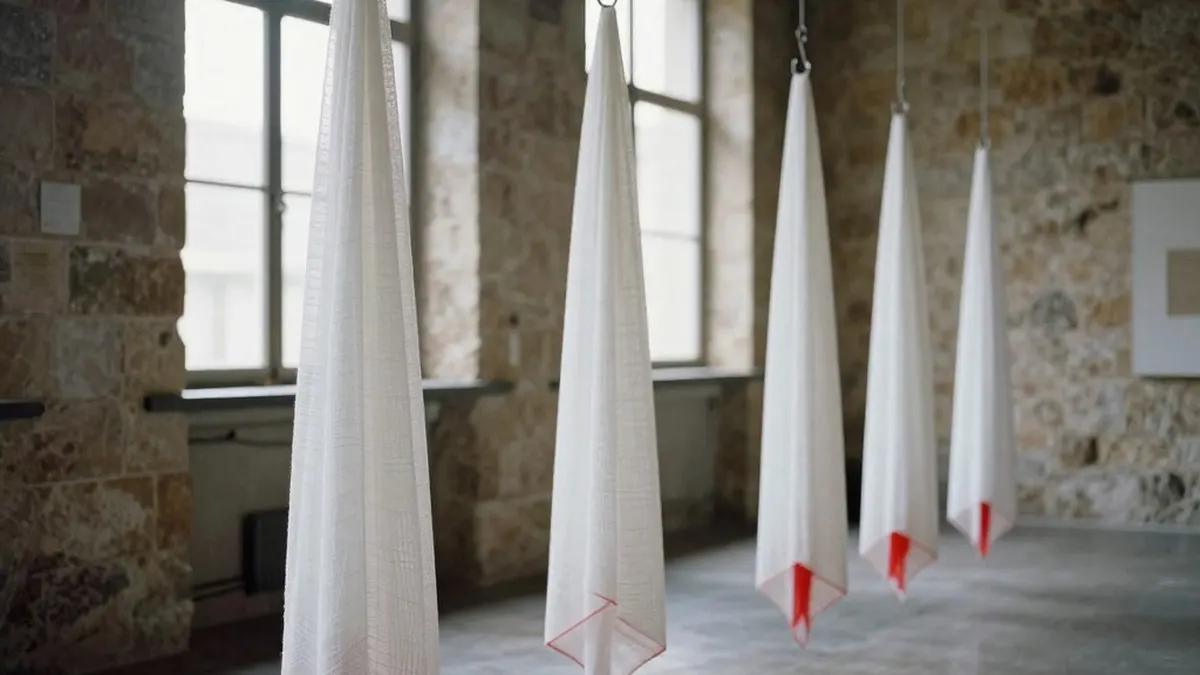
Ariane Littman, a multidisciplinary artist from Beit Zayit who was born in Switzerland, currently has solo and group exhibitions running at several venues across Israel. Her newest piece, Sanguine Fields, is on view at the former National Library of Israel building on the Hebrew University's Givat Ram campus, as part of the Jerusalem Biennale.
The work belongs to the Reflected Light: An Active Vision set, which draws on Mordechai Ardon's monumental stained-glass triptych, Isaiah's Vision of Eternal Peace, created more than 40 years ago. The biblical image of swords beaten into plowshares remains relevant, the article notes, as political violence continues to claim lives around the world.
Littman's installation refers to Oct. 7 and its aftermath, including the long hostage ordeal. Red-tipped white gauze drapes hang from butcher's hooks beside an enamel bowl. The bowl alludes to the incantation bowls that Jews, Christians and Mandaeans used to ward off evil spirits, and it carries the date 7.10.23 written dozens of times in tiny numerals on its inside and outside. Dried blood-red residue sits in the bowl, left by gauze soaked in red that dripped overnight. Littman had planned a receptacle under every drape but chose not to overwhelm visitors.
She says she was paralyzed for six weeks after the Hamas attack and could not make art. The only thing she managed was to mark the date, and she did so for a year. She also visited a museum to look at incantation bowls, since she had not known of their Babylonian origin. Littman says she followed events on television closely, and that listening to relatives of victims and hostages felt like hearing Holocaust testimony.
Gauze has been a recurring element of her work since 2009, when her nine-year-old daughter, Kalia, suffered third-degree burns on a school trip after a large pan of boiling water and oil spilled on her. The bandages Littman helped apply became part of her artistic toolkit. In her Talpiot studio, gauze layers partly cover Israeli flags and rough outlines of the national map. Some pieces use yellow thread to suggest surgical repair, and one scatters yellow thread around Gaza to roughly mark where hostages were held, echoing the yellow ribbons of solidarity.
Art was not her first path. After moving to Israel from the French-speaking part of Switzerland in the 1980s, she earned a degree in Middle Eastern studies and international relations at the Hebrew University. Her father, David, an English-born archaeologist, had secretly taken part in a 1961 Mossad operation to bring Jewish children out of Morocco, and her mother is the 93-year-old writer who uses the pen name Bat Yeor. The death of her brother, Daniel, who took his own life at 23, changed her direction. "Life is short. I have to do what is really important," she told herself, and she applied to Bezalel and was accepted.
Her career has been varied. She worked as a photojournalist during the Second Intifada, learning on the job with her father's old Leica and tips from colleagues, including neighbor Rina Castelnuovo of The New York Times. She says an artist can stay in the studio or treat the field as the studio, and she prefers the latter. "I chose to be in the place of the emotion and exploration," she says.
Her installation In the Eye of the Storm, part of the ongoing Wounded Land series, is on show at the Yigal Alon Centre in Ginosar on the Kinneret. It features two bereaved mothers, Liat Friedman and Layla Abbas, whose sons Shahar Friedman and his commander Jamal Abbas were killed in Gaza while trying to save fellow soldiers. The mothers wrap gauze around Chana Orloff's Mother and Child sculpture at Kibbutz Ein Gev. Littman once also allowed herself to be fully wrapped in bandages and pushed out onto the Dead Sea.
Several of her works are also at the Haifa Museum of Art, and a book titled "Art in A Time of War After Oct. 7, Wounded Land 2023-2026" is forthcoming. Littman says she once questioned whether art mattered amid so much violence. A visit to the Picasso museum in Paris, where wartime works still moved her, convinced her that it does.
Source: The Jerusalem Post